site templates free download

Sri Lanka at a Glance

Sri Lanka, formerly Ceylon, island country lying in the Indian Ocean and separated from peninsular India by the Palk Strait. It has a maximum length of 268 miles (432 km) and a maximum width of 139 miles (224 km). 

Proximity to the Indian subcontinent has facilitated close cultural interaction between Sri Lanka and India from ancient times. At a crossroads of maritime routes traversing the Indian Ocean, Sri Lanka has also been exposed to cultural influences from other Asian civilizations. Ancient Greek geographers called it Taprobane. Arabs referred to it as Serendib. Later European mapmakers called it Ceylon, a name still used occasionally for trade purposes. It officially became Sri Lanka in 1972.

The distinctive civilization of Sri Lanka, with roots that can be traced back to the 6th century BCE, is characterized by two factors: the preservation of Theravada Buddhism (the orthodox school of Buddhism having its literary traditions in the Pali language) and the development over two millennia of a sophisticated system of irrigation in the drier parts of the country. This civilization was further enriched by the influences of Hinduism and Islam.

Colombo, which emerged as the main urban centre during British rule, remains the executive and judicial capital of Sri Lanka; Sri Jayewardenepura Kotte, a Colombo suburb, is the legislative capital. This island nation has a pristine coastline, a unique culture and heritage, and is easy to access.

Almost whole of Sri Lanka experiences tropical type of climate. The location of Sri Lanka is a very decisive factor in long range flight planning (ETOPS). Sri Lanka is in close proximity to the Equator; situated in between 6N to 10N of the latitude and 80E to 82E of the longitude. Thus, the average temperature of Sri Lanka remains in between 27C to 31C. Most of the land is flat and rolling mountains in the south-central region rise to over 8,000 ft (2,438 m).

Time: GMT+5:30hrs (daylight saving or summer time is not applicable)

VCCF - Notams
  • Notam 13.11.30 VCCF_CTR and VCBI_APP positions serve both VCBI & VCRI arrivals and departures.
  • Notam 15.09.17 KATUNAYAKE (KAT) VOR frequency changed to 114.10.
  • Old KAT frequency 112.70 is still available for flight sim navigation.
  • Notam 16.06.16 Procedural agreement of India vACC and SRM vACC for flight operations between VCCF & VOMM established. Read the LOA.
  • Notam 19.04.11 Vatspy, Servoinfo data updated with additional Maldives airports.
  • Notam 21.11.30 VCBI Cargo apron E procedure published.
  • Notam 21.12.30 Taxiway P identified.
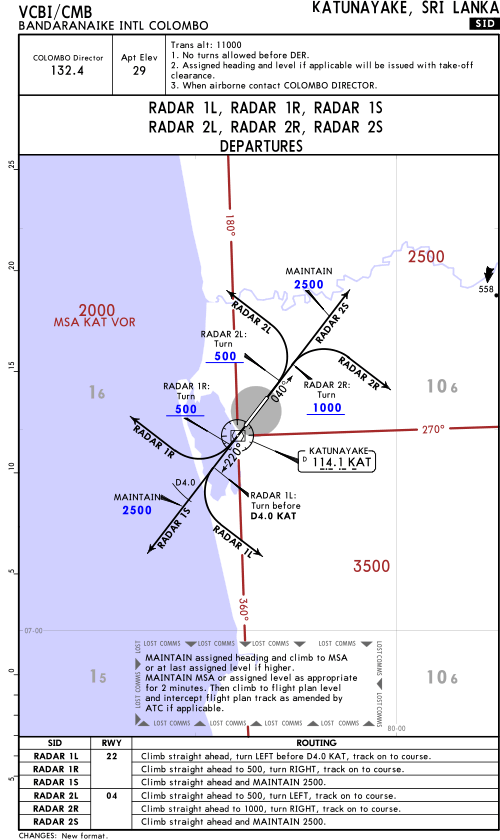
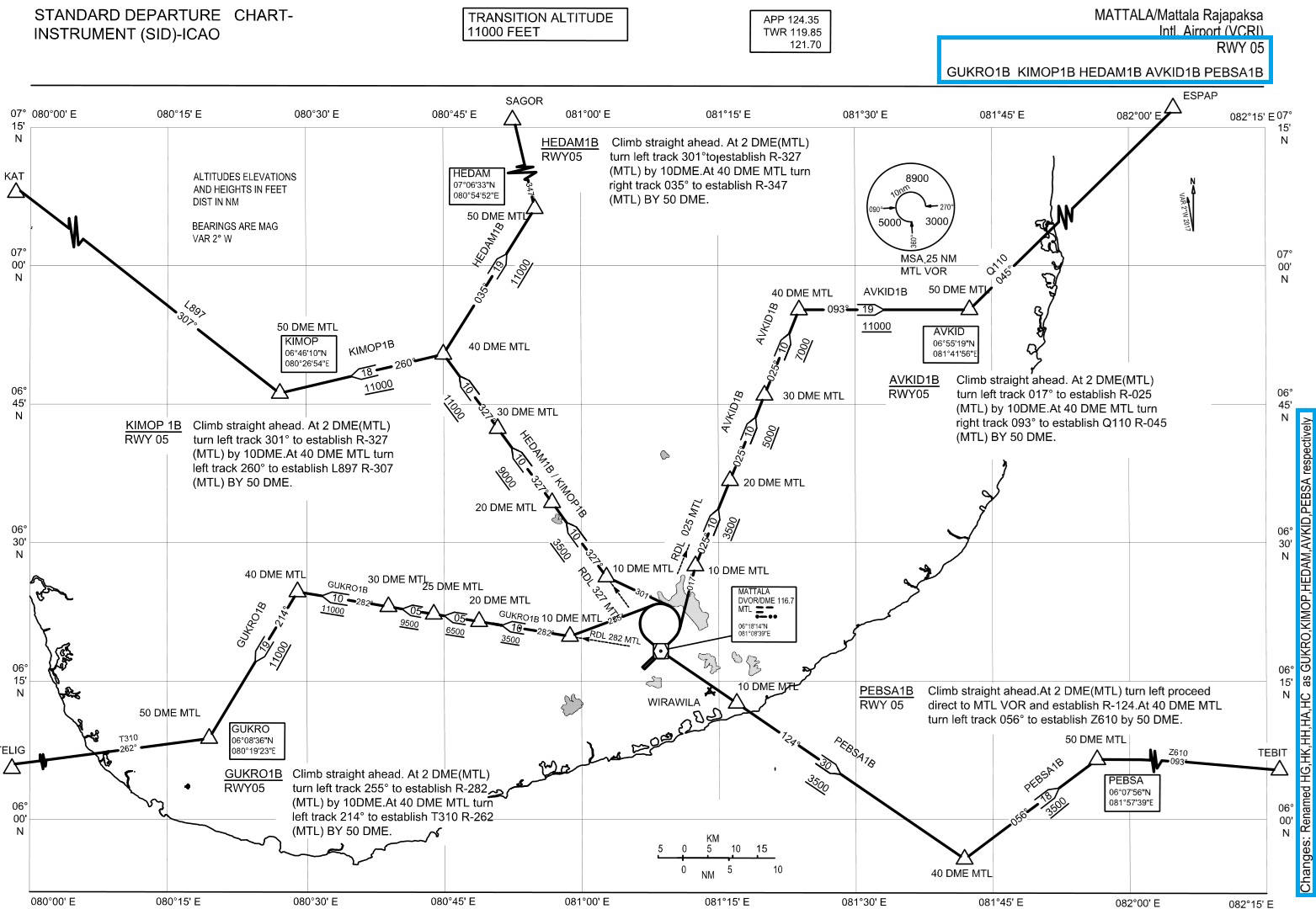
  • Notam 24.08.04 New waypoints introduced in VCBI & VCRI procedures. Refer airport charts below.
  • Notam 25.01.16 VCCC Ratmalana & VCCJ Jaffna Intl airports are active.

VCCF - Controller Files

Note: New KAT VOR 114.10 is in the same location of old KAT VOR 112.70.
Flight simulator flights can be operated using either frequency.

VCBI Landing Charts
VCBI Approach Charts
VCBI Departure Charts
VCRI - Mattala Rajapakse Intl. Charts

VCCC - Local Aerodrome Regulations

1. Light aircraft operations at Colombo INTL Airport - Ratmalana VCCC

1.1 VFR operations.
1.1.1 Light aircraft operations normally be conducted under VFR, within 10 NM radius of Colombo International Airport, Ratmalana.
1.1.2 For circuit and landings or local flights of not more than 30 minutes duration, verbal flight notification is acceptable. In such cases the following information shall be provided to the tower.
 - Aircraft identification and type
 - ETD
 - Flight duration
 - Area of flight operation
1.1.3 Light aircraft operations is authorized at the discretion of ATC when traffic conditions permit.
1.1.4 It is the sole responsibility of the pilots of all light aircraft to watch out for other traffic and maintain adequate separation with them.
1.1.5 During day time (0030 to 1230 UTC) VFR traffic from VCCC to northern destinations and vice versa be permitted through VCR23 along the track defined by three waypoints (R6, R7 and R8) as below.
  R6 – 065211.61N 0795317.44E
  R7 – 065659.38N 0795512.98E
  R8 – 070141.69N 0795517.45E
The minimum ALT to be maintained along this track within VCR23 be restricted to 2000 FT.
1.1.6 Right turns for traffic departing from RWY22 VCCC be permitted subject to be cleared of VCR23 or when compliant with conditions as per 1.1.5 above.
1.1.7 Light aircraft in the right hand circuit of RWY22 and left hand circuit of RWY04 may be accommodated subject to clear of VCP07, VCP34 and VCR23.

1.2 VFR route - "A"
1.2.1 VFR route "A" is provided to allow aircrafts (CAT A & CAT B) flying on VFR, to transit through "Local VFR Flying Training" areas (VCT-01 to VCT-06). During day time under the VMC, traffic from VCCC to southern destinations and vice versa be permitted through training areas VCT-01 to VCT-06 along the track defined by seven waypoints (V1, V2, V3, V4, V5, V6 and V7) mentioned below.
  V1 – 064744N 0795320E (Tyron Fernando INTL cricket ground)
  V2 – 064627N 0795256E (Moratuwa railway station)
  V3 – 064258N 0795357E (Panadura beach - Break water)
  V4 – 063501N 0795630E (Abeam “Kalu” river outfall)
  V5 – 062740N 0795840E (Beruwala fish harbour)
  V6 – 061608N 0800200E (Balapitiya beach)
  V7 – 061135N 0800343E (Akurala beach)

1.2.2 The minimum ALT to be maintained along the VFR route “A” above is, 1500 FT AMSL.

1.3 IFR operations.
1.3.1 Requests for operations under IFR is approved if the aircraft is suitably equipped for IFR operations and the pilot is appropriately rated. The controller shall be the final authority in authorizing such operation from the point of view of air traffic.

1.4 Cross country flights
1.4.1 The pilot should obtain briefing and clearance from any available VCCF controller. The flight shall be conducted strictly in accordance with the clearance obtained.

VCCJ - Local Aerodrome Regulations

  Aircraft operations at Jaffna INTL  Airport  - VCCJ

1.  VFR operations 
1.1  VFR/IFR operations are permitted and IFR traffic should change to VFR before entering Jaffna Control Zone (CTR). 

2.  Start-up clearance 
2.1  Aircraft start-up is allowed only with prior approval from Jaffna Tower or area controller. 
2.2  Special procedure for start-up by aircraft  which intend to enter Chennai FIR.
2.2.1 The Pilot of an aircraft who intends to enter Chennai FIR shall notify ATC twenty minutes (20 MIN) prior to start-up using the following phraseology format. 
 - Call sign
 - Destination
 - Proposed altitude / Flight level
 - Parked position
 - “Ready to start in twenty minutes”
2.3  All other aircraft shall request startup clearance from Jaffna Tower or area controller when ready. 
2.4  Aircraft engine ground run-up restrictions.
2.4.1 On the apron, no aircraft is allowed for engine ground-run except on idle power, and with approval from the Jaffna Tower. 
2.4.2 Aircraft engine run-ups other than on idle power are allowed only on the runway or taxiway-Z with nose-in position towards the apron, with approval from the Jaffna Tower. 
2.4.3 Before allowing engine run-ups to be carried out on the taxiway-Z, Jaffna Tower will ensure adequate measures are taken for safety of other aircraft

3.  Aircraft taxiing 
3.1  Only taxiway-Z is available for civil aircraft operations to and from apron (See the Parking Chart). 

4.  Aircraft parking 
4.1  Parking stands at the apron are allocated by the Jaffna Tower for all aircraft ensuring the optimum use of the apron. 
4.2  Only nose-in/taxi-out (power-in/power-out) parking is permitted in the allocated stand on the apron.


Flyantics

Santa Claus, like all pilots, gets regular visits from the Federal Aviation Administration, and the FAA examiner arrived last week for the pre-Christmas flight check.

In preparation, Santa had the elves wash the sled and bathe all the reindeer. Santa got his logbook out and made sure all his paperwork was in order. He knew they would examine all his equipment and truly put Santa's flying skills to the test. 

The examiner walked slowly around the sled. He checked the reindeer harnesses, the landing gear, and Rudolph's nose. He painstakingly reviewed Santa's weight and balance calculations for the sled's enormous payload. 

Finally, they were ready for the checkride. Santa got in and fastened his seatbelt and shoulder harness and checked the compass. Then the examiner hopped in carrying, to Santa's surprise, a shotgun. 

"What's that for?" asked Santa incredulously. 

The examiner winked and said, "I'm not supposed to tell you this ahead of time," as he leaned over to whisper in Santa's ear, "but you're gonna lose an engine on takeoff."

© 2013-2025 vACCSRM